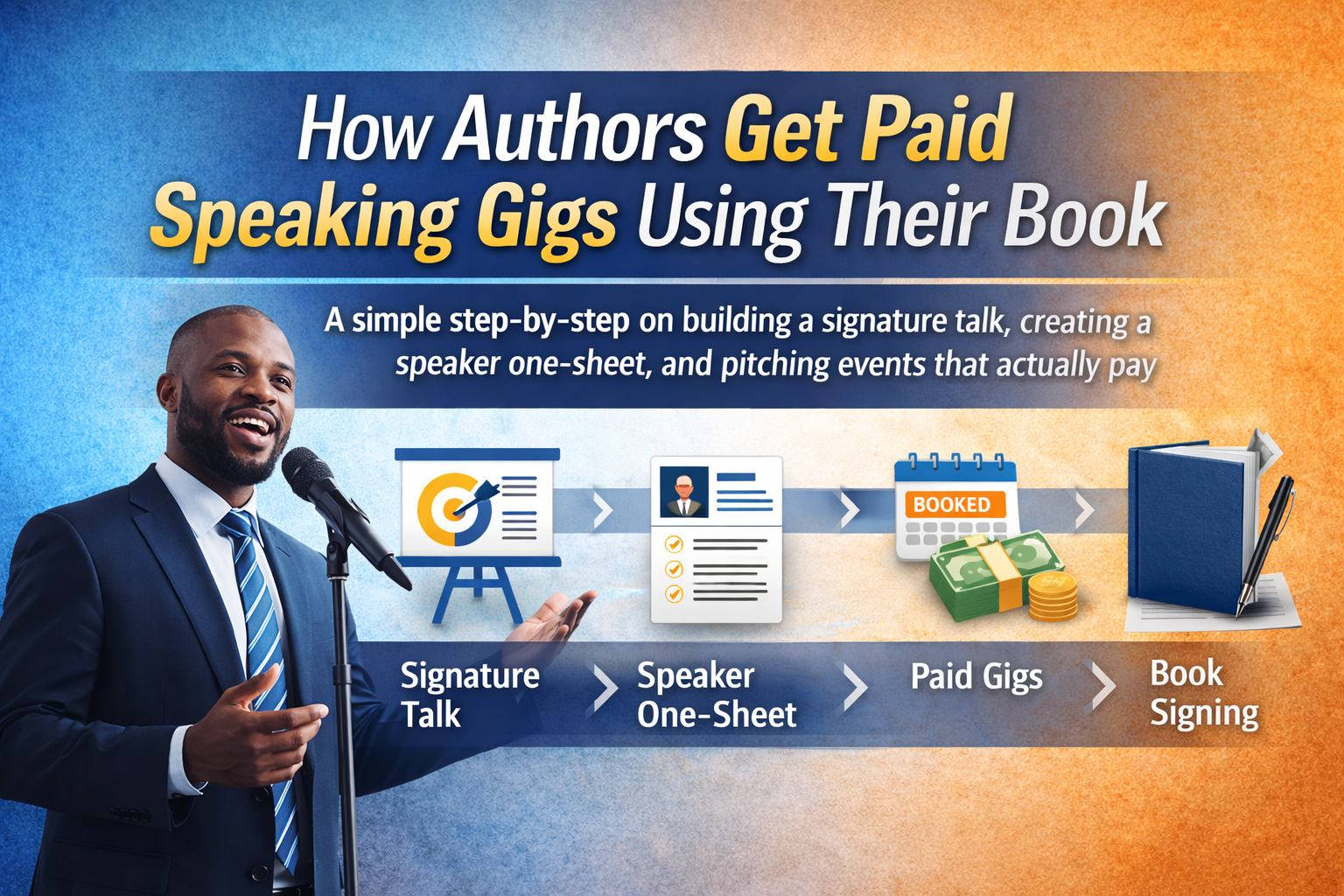
A simple step-by-step on building a signature talk, creating a speaker one-sheet, and pitching events that actually pay
A book is not just something you sell. It is proof that you have a message worth listening to. When you use your book the right way, it becomes your best tool for getting paid speaking gigs. The mistake most authors make is waiting for someone to “discover” them. Paid speaking is not about being famous. It is about being clear, prepared, and easy to book.
Here is a simple step-by-step plan to go from “author” to “paid speaker” without overcomplicating it.
First, pick the right angle from your book. Your signature talk should not be your entire book. It should be one clear outcome that your audience wants. Ask yourself: what is the main problem my book solves, and who needs that solution right now? The more specific the outcome, the easier it is to sell you to an event planner. For example, “How to Write a Book” is too broad. “How to Outline Your Book in 60 Minutes So You Stop Stalling” is specific and bookable.
Next, turn that angle into a signature talk with a simple structure. A strong talk has three parts: the problem, the process, and the proof. Start by naming the problem in a way that makes people feel seen. Then teach a simple process that gives them quick wins. Finally, give proof through a story, a result, or a clear example. You do not need a fancy speech. You need a talk that is easy to follow and delivers real value. A good rule is to build your talk around three key points. If you can explain it in three points, people can remember it, and event planners can sell it.
After that, create a clear title and description. Your title should sound like a result, not a topic. A topic is “confidence.” A result is “How to Build Confidence Even When You Feel Behind.” The description should tell who it is for, what they will learn, and what will change for them after the talk. Keep it short and clear. Event planners do not have time to decode your message.
Now you need a speaker one-sheet, which is basically your “booking flyer.” This is what makes you look professional, even if you are new. Your one-sheet should include your name, headline, a strong photo, your talk titles, a short bio, the outcomes for the audience, and how to book you. Add a few credibility points like media features, past stages, client results, or your book’s key details. If you do not have a long speaking history yet, that is fine. Use what you have: your author status, your expertise, and any results you can show.
Then get your offer and pricing together. Many authors either charge too little or they don’t know what to say when someone asks their fee. Decide what you want to charge for local events, out-of-state events, and corporate or conference events. Also decide what is included, such as a keynote, breakout, workshop, or a book signing. You can also create packages. For example: a keynote fee plus a bulk book order, or a workshop plus a Q&A plus books for attendees. This is where your book helps because it adds value and makes you easier to say “yes” to.
Once your talk and materials are ready, start pitching the right places. Paid events are usually conferences, associations, corporations, universities, churches with budgets, nonprofits with sponsors, and leadership organizations. Do not only chase “free exposure” events. Exposure is fine, but it is not the goal. Look for events that already pay speakers or have sponsorship money, ticket sales, or professional funding.
When you pitch, keep it simple. Event planners want three things: what you talk about, who you help, and what result their audience will get. Send a short email or DM with your one-sheet and a clear subject line. Make your message about their audience, not about you. Tell them you are available, share one signature talk title, and ask if they are currently booking speakers. You do not need a long story. You need a clear offer.
Here is a simple pitch you can model: “Hi [Name], I’m an author and speaker who helps [audience] achieve [result]. I’d love to be considered for your upcoming [event]. One of my most requested talks is ‘[Title]’ where attendees learn [3 outcomes]. Are you currently booking speakers? I can send my speaker one-sheet and a quick video clip.” That is it. Clean, professional, and focused.
After you pitch, follow up like a business owner. Most paid gigs are not booked from the first message. Follow up in 5–7 days, then again two weeks later. Keep it polite and short. You are not begging. You are reminding them you exist. If they say no, ask when they book for the next season and stay in touch. Consistency wins.
Finally, make it easy for people to hire you. Have a simple booking link or email, a short speaker reel if you can, and a clear next step. If you do not have a speaker reel yet, record a clean 2–3 minute video introducing your talk and who it is for. Most people never do this, so doing it puts you ahead fast.
Your book can open doors, but only if you present it as a tool that delivers results. Paid speaking comes when you stop trying to be “chosen” and start showing up prepared, positioned, and clear. Build one strong talk, package it the right way, and pitch consistently. You will be surprised how quickly opportunities start to show up when you treat speaking like a business.